72 hr
Mount Bromo & Ijen Crater 3D2N Volcano Tour
Chase sunrise over Bromo and blue fire at Ijen on a 3-day East Java volcano adventure.
Reserve
Hand-picked by our editors — only the best 5 multi-day volcano tours from 40 reviewed.
Verified partners for every tour, free cancellation where available, and instant confirmation on every booking.
72 hr
Chase sunrise over Bromo and blue fire at Ijen on a 3-day East Java volcano adventure.
Reserve
72 hr
Chase sunrise over Bromo and hike to Ijen's blue flames on a 3-day trip from Java to Bali.
Reserve
96 hr
Waterfall, volcano sunrise and blue fire crater across East Java, finishing in Bali.
ReservePrices from verified partners. Availability updates in real time at checkout. Free cancellation policies apply where shown.
The landmarks, rooms, and views travelers on this tour remember — all visible on a single visit.
The active crater is the visual center of the park, and the access route is defined by the official 250-step note. From the rim, you see the smoking cone, the ash plain, and the wider Tengger caldera in one sweep.
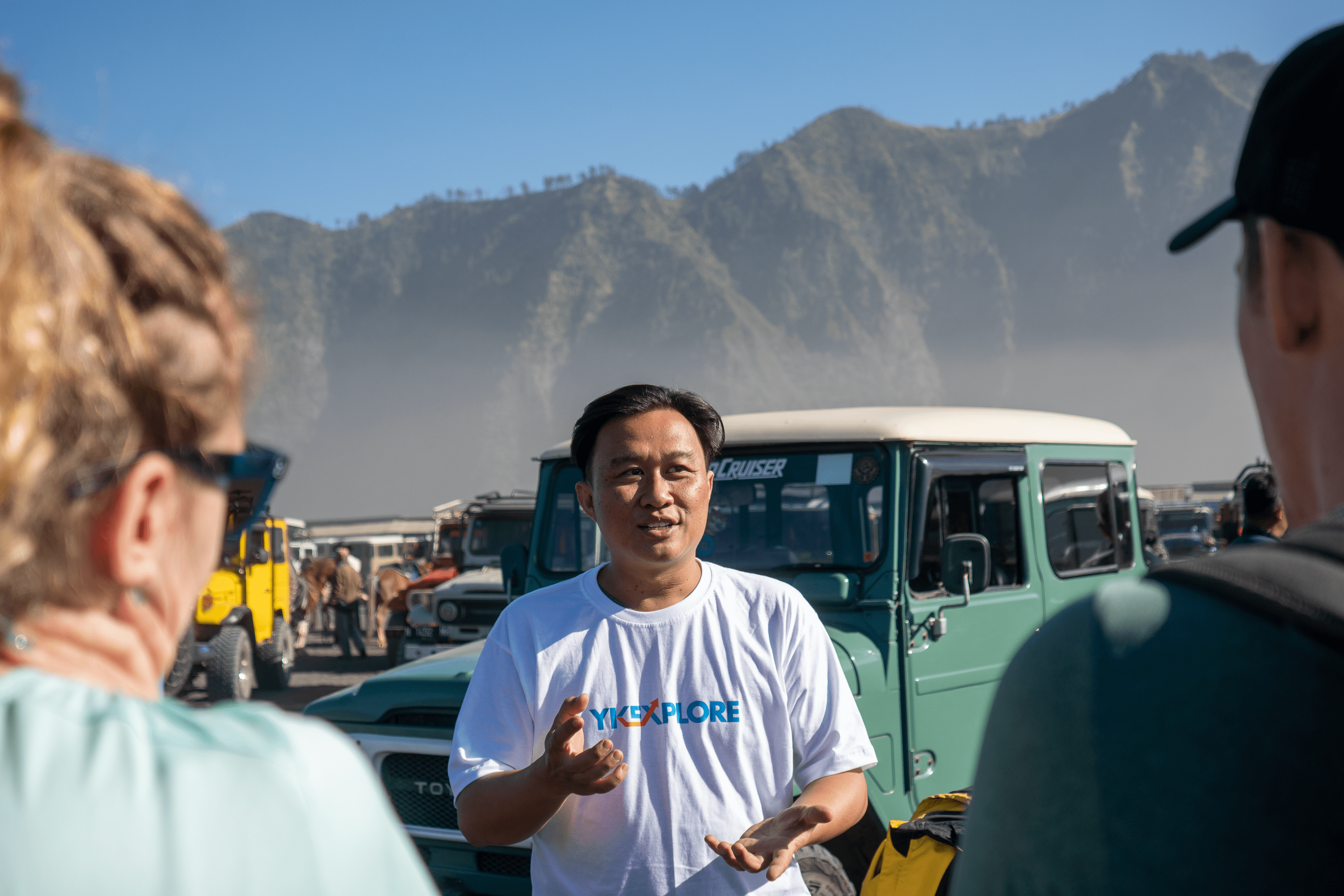
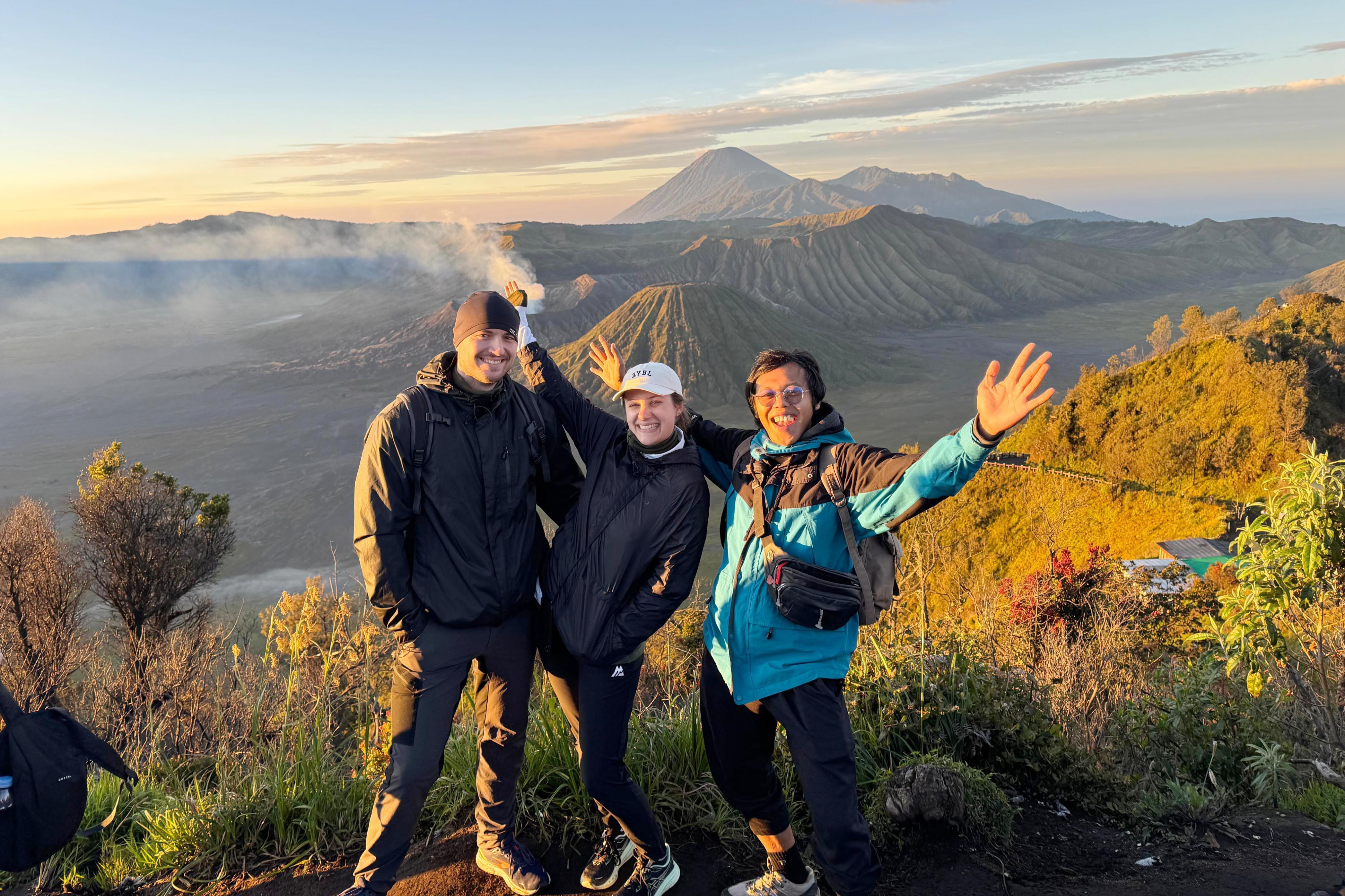
This is the main sunrise lookout for a bromo ijen tour from yogyakarta, and it is where most iconic dawn photos are taken. The high elevation gives a broad view of the sea of sand and the volcano silhouettes before the morning haze builds.
The Tengger sea of sand is a rare volcanic desert that spreads between the viewpoints and the crater. It is part of what makes the park feel different from a normal mountain destination, especially when jeeps cross the open plain before dawn.
This Hindu temple sits in the volcanic field and reflects the living Tengger culture around the mountain. It gives the visit a cultural layer beyond the sunrise spectacle and is closely tied to local ritual life.
The green slopes here contrast sharply with the black sand and crater terrain. The hillside is often used as a softer landscape stop when the weather is clear and the jeep route has time for a detour.
This is the final climb before the crater rim, and the steps make the visit feel more physical than a drive-through viewpoint stop. The numbered access is one reason the site can be challenging even for short visits.
They complement each other, but most travelers who compare a road-based bromo ijen tour from yogyakarta with the train-led overland route find the rail start more relaxed and the all-car version more direct for sunrise timing. If your priority is smoother transfers on a Yogyakarta-to-Bali plan, the train-based option usually wins on comfort while the road-first route keeps the pace simpler.
| Feature | Top pick Bromo Ijen Tour from Yogyakarta | Yogyakarta to Bali: 3 Day Bromo & Ijen Tour |
|---|---|---|
How you start |
Train to Surabaya, then car | Overland by road from Yogyakarta |
Main transfer style |
Rail-plus-car handoff | Mostly private car/van |
Comfort |
Higher; window seat | Lower; longer road hours |
Schedule flexibility |
Set train timetable | More flexible pickup timing |
Best fit |
Yogyakarta-to-Bali travelers | Direct Bromo-Ijen transit seekers |
Overall pace |
More relaxed transfers | More direct, fewer changes |
| See tickets → |
Verdict: Choose the train-based overland route for a calmer, more comfortable transfer pattern, and pick the road-based bromo ijen tour from yogyakarta if you want the most direct sunset-to-sunrise flow into Bromo and Ijen.
Choose your ticket, select your date, and reserve in under two minutes. Secure checkout handled by our verified partner.
Instant confirmation by email, with a mobile voucher you can save offline. No printing, no queuing at a collection desk.
Arrive at the entrance, show your voucher on your phone, and walk in. Most tickets include priority or skip-the-line access.
Practical details for your visit straight from our verified partners — hours, access, rules, and how to get there.
Bromo Tengger Semeru National Park, East Java, Indonesia
Common jeep gateway for sunrise trips
Most travelers use a private car or tour van from Yogyakarta, then switch to a local jeep near the park. The long haul is usually overnight or broken into a two-day transfer because Bromo sits far east of Yogyakarta.
Train or bus combinations typically run Yogyakarta to Probolinggo, Malang, or Pasuruan, followed by a local transfer into the park. This is slower than a direct car and often means an overnight stay before sunrise.
A long-distance taxi or hired driver is the simplest point-to-point option if you want fewer connections. Use this for the final approach to the park, not for the entire Yogyakarta-to-Bromo journey unless you are paying for a private intercity transfer.
Not practical for the full Yogyakarta-to-Bromo route because of distance, night driving, and mountain conditions. Short local rides near accommodation are possible, but the main transfer is better done by car or arranged tour.
Dress for cold pre-dawn wind, ash, and uneven ground. Closed shoes with grip are more practical than sandals for the crater area and the stair climb. For a bromo ijen tour from yogyakarta, layer a windproof jacket over quick-dry clothing because temperatures can change quickly between the viewpoint and the caldera floor.
Use a small daypack; large suitcases are awkward in jeeps and on steep access points. Keep cash, ID, and your ticket confirmation in an easy-to-reach pocket for park checks. Security screening is light compared with an airport, but bags may be checked for prohibited items on entry roads or at managed viewpoints.
Sunrise photography is the main draw, especially from high viewpoints overlooking the sea of sand and Mount Bromo’s crater. Commercial filming or prewedding shoots require prior permission according to the park’s visitor rules. Drones are not a default free-for-all in protected areas; confirm permission before bringing one for a bromo ijen tour from yogyakarta.
The official park information lists 250 steps of access, so the route is not wheelchair-friendly. Expect stairs, loose volcanic sand, and uneven ground near the crater rim. If mobility is limited, focus on jeep-access viewpoints rather than the crater approach, and plan the bromo ijen tour from yogyakarta with extra transfer time.
Mobile coverage can be uneven around the caldera and viewpoints, so download maps before departure. Save the official park phone number and your operator contact offline. A power bank is helpful because early departures, long transfers, and photo use drain batteries quickly.
Families can visit, but very young children may struggle with the early start, cold wind, and stairs. A sunrise plan works best when everyone can sleep during the transfer or the post-sunrise return. Bring snacks, warm layers, and a child carrier for sections where strollers are impractical.
Food stalls and roadside warungs are more useful than formal dining inside the park. Bring water before the pre-dawn departure, because the coolest hours are also the easiest time to underestimate dehydration. Alcohol is not part of a normal bromo ijen tour from yogyakarta and should not be relied on for warming up in the cold.
Pets are not a good fit for the crater, jeep routes, or crowded sunrise viewpoints. The ash, cold, and vehicle transfers make this a poor environment for animals. If you are traveling with a service animal, confirm access rules in advance with park staff.
The official site shows online booking and human-only access rules for reservations, so do not rely on automated scripts. For a bromo ijen tour from yogyakarta, book transport and tickets early because sunrise slots and jeep logistics shape the whole day. The park operates with a hard cutoff at 17:00, so build all sightseeing around that window.
Bromo Tengger Semeru National Park, East Java, Indonesia
Common jeep gateway for sunrise trips
Get directionsBest time to go, insider tips, nearby landmarks, and the cancellation fine print — flip through to skim what matters to you.
How crowds, weather, and events shift across the year.
March to May usually brings dry-to-moderate weather and clearer dawns than the wettest months. Crowds are still manageable on weekdays, and the cooler pre-sunrise air suits the 03:30–06:30 arrival window.
June to August is peak season for visibility and sunrise demand. Expect more vehicles, stronger competition for viewpoints, and colder dawn temperatures in the caldera.
September to November can still be excellent for the bromo ijen tour from yogyakarta, with stable skies early in the day. It is a good shoulder period before the heaviest rains return.
December to February is wetter and can bring lower visibility, muddy tracks, and slower jeep operations. If you travel then, leave extra time for road conditions and photo stops.
Small details that turn a good visit into a great one.
The 03:30–06:30 arrival window matters more than a daytime arrival because the light and temperature are the whole point. If you miss the early window, you also miss the best visibility and the smoothest jeep circulation.
Traffic, weather, and jeep staging can shift timing by 30–60 minutes. Build slack into the bromo ijen tour from yogyakarta so you are not rushing the crater stairs.
The pre-dawn chill can be severe, but the caldera warms quickly after sunrise. A layered setup is easier than carrying a bulky jacket all day.
Local jeep fees, drinks, and roadside toilets are often easier with cash than card. Keep it separate from your main wallet so you do not open everything in dusty conditions.
Use a lens cloth and keep the camera in a sealed bag during jeep rides. Fine volcanic dust can get into zippers, buttons, and zoom rings quickly.
The route uses 250 steps, and the ascent is more tiring than the number suggests because of altitude and loose footing. Pace yourself and pause on the landings instead of rushing.
Jeep parking areas and crater access points can look similar in low light. Mark your vehicle or driver contact before walking away so the return is simple after sunrise.
Non-bookable sights within a short walk — free to visit, easy to pair.
Classic sunrise lookout over the Tengger caldera. It is one of the most photographed places in the park, and reaching it before dawn is the reason many bromo ijen tour from yogyakarta itineraries start so early.
A wide volcanic plain that separates the viewpoints from the crater zone. The open terrain makes jeep travel feel fast but also exposes you to wind and ash.
A Hindu temple at the foot of the crater area, important to local Tengger rituals. It adds cultural context to the volcano landscape and is often passed on the way to the stairs.
The final access route to the crater rim, with roughly 250 steps in the official visit notes. The climb is short in distance but demanding because of altitude, ash, and foot traffic.
A green hillside area away from the crater that is often visited as a contrast to the black sand plain. It is a popular jeep add-on when weather and timing allow.
Flexible, no hidden fees.
Bromo tickets are non-refundable once issued unless the operator or park authority states otherwise on the booking record. If a tour package includes the 255,000 IDR foreign adult park fee, treat that fee as part of the confirmed booking total and verify the package terms before payment.
Hand-picked options within walking distance — pick a district for vibe, or a specific hotel for convenience.
Most practical base for sunrise access, with homestays and simple lodges near the jeep departure points. Staying here reduces the pre-dawn transfer burden on a bromo ijen tour from yogyakarta.
Useful for travelers who want more hotel choice and easier rail or road connections. You will still need an early jeep transfer into the park.
A larger city base with broader lodging options and easier access to food and services. It is less convenient for sunrise than Cemoro Lawang, but better for multi-stop East Java trips.
Good as a transit stop if your route comes from the west or if you are linking Bromo with other East Java sites. Choose this if you prefer city comforts over immediate crater access.
Kawah Ijen holds a crater lake nearly one kilometre wide with a pH close to 0.5, acidic enough to dissolve steel. Its counterpart to the west, Mount Bromo, rises only 2,329 metres — modest by Javanese measure. What distinguishes it is the ground around it: a caldera some ten kilometres across, floored in grey ash the Tengger people call the Sea of Sand. A bromo ijen tour from yogyakarta links the two across roughly 350 kilometres of East Java. Bromo takes its name from Brahma. The Tengger, a Hindu community that remained on the highlands after Islam spread across Java, have kept ritual life on the caldera floor for centuries. Pura Luhur Poten stands unroofed at the base of the cone, built from black volcanic stone and aligned to the crater. Each year at Yadnya Kasada, offerings of rice, fruit and livestock are cast into the smoking vent, settling a debt attributed to a Majapahit-era queen. The mountain is not scenery in this reading. It is a creditor. Above it, the Penanjakan ridge closes the caldera's northern rim at 2,770 metres. The Ijen complex, above Banyuwangi at Java's eastern edge, operates on different chemistry. Sulphurous gas escapes at over 500 degrees Celsius through ceramic pipes set into the solfatara; where it meets oxygen it ignites pale blue. Miners have carried the cooled yellow slabs out of the crater by hand since 1968, loads of 70 to 90 kilograms hauled up the crater wall twice a night. The blue fire that draws bromo ijen tour from yogyakarta tours is, described plainly, a visible byproduct of that trade. Both systems remain restless. Bromo's 2010 ash column grounded flights across East Java for weeks, and the cone has vented repeatedly since. Bromo Tengger Semeru National Park, gazetted in 1982, now protects some 50,276 hectares, including Semeru at 3,676 metres — the highest point in Java. The 255,000 IDR entrance fee for foreign adults funds ranger patrols across that terrain. Itineraries sold as wisata Bromo Ijen dari Yogyakarta, or simply as an East Java overland volcano trip, share this geography. Each bromo ijen tour from yogyakarta tour therefore crosses two districts, two mountains and two entirely separate volcanic mechanisms, in a landscape that remains, geologically speaking, unfinished.
"The mountain is not scenery in this reading; it is a creditor."
A step-by-step walkthrough of the visit — what you'll see, how long each stage takes, and the details that matter.
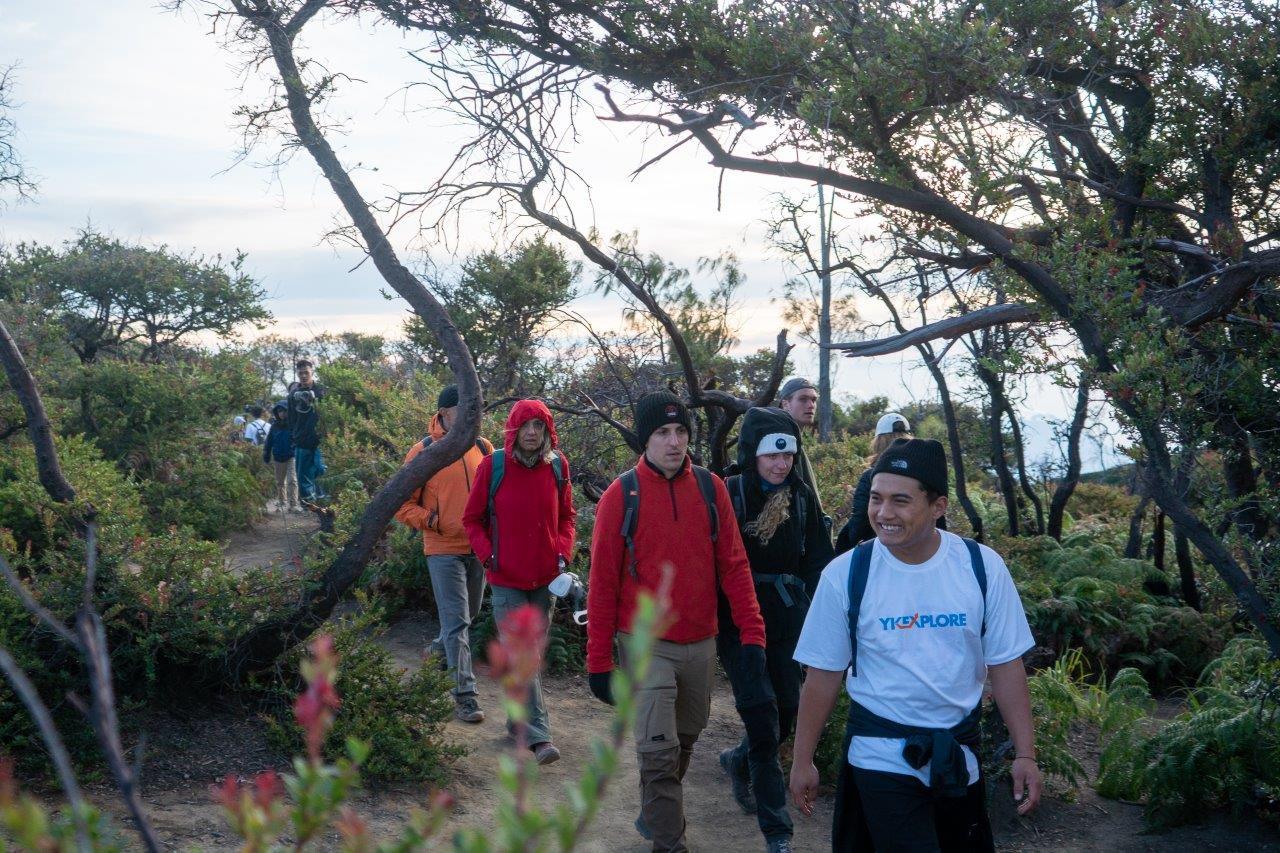
You leave Yogyakarta in the dark and wake somewhere east of Solo, the train or the minibus still moving. By the second afternoon the road climbs into the Tengger highlands, and the temperature drops fifteen degrees in an hour. The alarm goes early. You pull on everything you packed, meet the jeep, and climb through pine and ash to the viewpoint while the sky is still black. Arrival falls inside the 03:30–06:30 window, when the air is coldest and clearest. Sunrise comes; the caldera fills from the rim down. Then you descend to the Sea of Sand, cross it on foot or on horseback, and take the 250 steps up to the lip of the crater. The sound from inside is a low, continuous roar. The following night belongs to Ijen. You start the walk to the rim in the small hours, mask on, headlamp dimmed wherever the trail allows. The blue flames sit at the bottom of the crater, and you scramble down toward them past miners climbing the other way with full baskets. Dawn turns the lake a milky turquoise. Your bromo ijen tour from yogyakarta tickets close, on most itineraries, at a hotel in Banyuwangi or on the ferry crossing to Bali.
The official park hours are 00:00–17:00 every day, and sunrise access is why most visitors enter very early. The park information also lists a 17:00 cutoff for general visitation.
For sunrise, the best arrival window is 03:30–06:30. That timing gives you cooler air and the strongest chance of clear dawn light over Mount Bromo.
The official access count is 250 steps. Expect ash, steep footing, and pauses on the way up rather than a casual stair climb.
Yes, but it suits families best when children can handle cold pre-dawn travel and a long vehicle day. Bring warm layers, water, and snacks, and avoid a rushed schedule.
Wear closed shoes, a warm layer, and clothes that can handle wind and dust. A bromo ijen tour from yogyakarta often starts in cold air and ends much warmer after sunrise.
Bring only a small daypack; large luggage is awkward in jeep transfers and on the crater approach. Drones and commercial filming can require permission, so do not assume free use.
Food is usually obtained from roadside stalls, homestays, or packed supplies rather than formal dining inside the park. Water is essential because the early cold can mask dehydration.
Most travelers reach the park by private car, tour van, or train-plus-transfer combinations from Yogyakarta, then switch to local jeep transport near the crater zone. Parking and jeep staging are managed around gateway villages such as Cemoro Lawang.
Tour ticket refund rules depend on the booking terms, but the park’s visitor rules do not advertise a general no-questions refund. If your package includes the 255,000 IDR foreign adult fee, verify whether that amount is refundable before paying.
Good pairings include the Sea of Sand, Mount Penanjakan viewpoint, Luhur Poten Temple, and Teletubbies Hill. These are natural add-ons because they sit inside the same park landscape.