
12 hr
Private Mount Bromo Sunrise & Volcanic Crater Day Tour
Witness a magical Java sunrise and peer into an active volcanic crater on a private 4WD adventure.
Reserve
Ash plains before dawn, sulphur light after midnight.
Hand-picked by our editors — only the best 5 experiences from 140 reviewed.
Verified partners for every tour, free cancellation where available, and instant confirmation on every booking.
12 hr
Witness a magical Java sunrise and peer into an active volcanic crater on a private 4WD adventure.
Reserve
96 hr
Trek through spectacular canyons, watch the Bromo sunrise, and climb Mount Ijen on a multi-day adventure.
Reserve
48 hr
Trek to East Java's legendary active volcanoes to witness the Bromo sunrise and Ijen's magical blue flames.
ReservePrices from verified partners. Availability updates in real time at checkout. Free cancellation policies apply where shown.
The landmarks, rooms, and views travelers on this tour remember — all visible on a single visit.
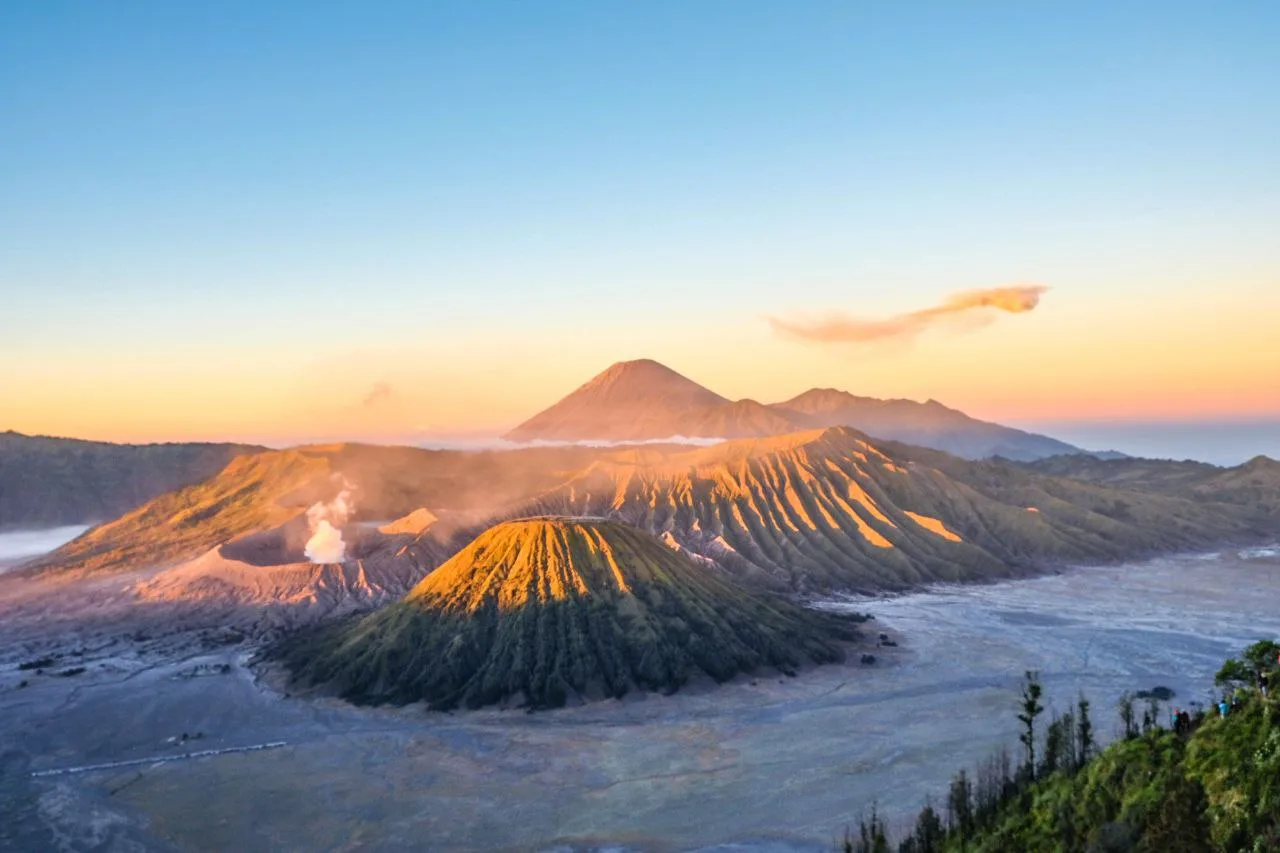
This is the classic sunrise lookout for the Bromo caldera and one of the most photographed places in East Java. From here you can often see Mount Bromo, Mount Batok, and Mount Semeru in a single frame, with Semeru rising to 3,676 meters.
The vast volcanic plain around Mount Bromo gives the area its desert-like look. It is part of the Tengger caldera landscape and is wide enough that jeep crossings feel like moving across a natural amphitheater.
Mount Batok is the cone that sits beside Bromo and often steals part of the sunrise composition. Its layered slopes and neat profile make it one of the most visually distinct volcanic cones in the park.
This Hindu temple stands on the caldera floor and serves as a ritual center for the Tengger community. Its placement in the sand plain makes it one of the most culturally important structures in the park.
The final approach includes a steep staircase and a sulfurous crater edge that frames the active vent. The crater is about 800 meters wide, and the climb up the steps is the part most visitors remember most clearly.
The wind-moving sand field is a quieter stop that shows how exposed the caldera is to weather and ash. Its shifting surface is a good contrast to the fixed temple and cone shapes elsewhere in the park.
They complement each other, but if you want the easier sunrise spectacle first, Mount Bromo usually wins; if you want the harder crater hike and blue-fire focus, Mount Ijen is the more dramatic pick. Many travelers do both on a longer East Java volcano tour, with Bromo feeling gentler and Ijen feeling more strenuous.
| Feature | Top pick Mount Bromo | Mount Ijen |
|---|---|---|
Scenery and main draw |
Sunrise caldera, sea of sand | Blue fire, acid crater lake |
Start time and effort |
03:00–05:30; jeep sunrise start | Midnight–02:00; steep hike |
Mobility/access |
Jeep-accessible viewpoints | Steep trail, guided hike |
Best fit for short trips |
Best for first-time short visits | Best if you want challenge |
Typical tour length |
Half-day sunrise visit | 6–8 hours from Banyuwangi |
How the day feels |
Cool, scenic, low-effort | Cold, physical, sulfur-heavy |
| See tickets → |
Verdict: For a first East Java volcano stop, choose Mount Bromo if you want the easier, more flexible sunrise experience, and choose Mount Ijen if the blue flame and crater hike are the main goal; if time allows, bromo ijen private tour tours often pair both, while bromo ijen private tour tour and bromo ijen private tour tickets searches usually point travelers to the same two-stop itinerary.
Choose your ticket, select your date, and reserve in under two minutes. Secure checkout handled by our verified partner.
Instant confirmation by email, with a mobile voucher you can save offline. No printing, no queuing at a collection desk.
Arrive at the entrance, show your voucher on your phone, and walk in. Most tickets include priority or skip-the-line access.
Best time to go, insider tips, nearby landmarks, and the cancellation fine print — flip through to skim what matters to you.
How crowds, weather, and events shift across the year.
Dry-season months usually give the clearest sunrise views and the most reliable roads. Expect colder dawn temperatures and higher demand for jeeps and lodging during school holiday periods.
These months often keep good visibility, especially in September and October. November can bring fog and slick tracks as the wet season approaches.
Rain and cloud cover are more common, which can reduce sunrise visibility. Paths can feel wetter and the Sea of Sand can become muddy after heavy rain.
Shoulder-season weather is often more manageable than peak-rain months, with fewer crowds than the June-to-August rush. This is a practical time for a quieter bromo ijen private tour.
Indonesian holidays and long weekends can create heavy jeep queues. If you want easier access, avoid peak holiday dates and aim for a weekday departure.
Small details that turn a good visit into a great one.
For a bromo ijen private tour, plan your viewpoint arrival around 03:00–05:30 so you are settled before the sunrise window. That timing also helps you avoid the most crowded photo spots at Penanjakan.
The viewpoint can feel very cold before sunrise, even in the dry season. A warm layer and gloves are more useful than a heavy daytime jacket because temperatures rise quickly after sunrise.
The Sea of Sand and crater approach are loose underfoot, so trail shoes or sneakers with grip are better than sandals. This matters most if you want to walk from the jeep stop to the stairs.
Some small vendors and transport helpers around the gateway villages prefer cash. Bring enough Indonesian rupiah for food, tips, and incidental fees so you are not dependent on card acceptance.
Wind can carry sulfur fumes near the crater rim, so a mask is practical, not optional. If you have asthma or another respiratory issue, stay farther back from the active vent.
In July, August, and holiday periods, the jeep supply can tighten fast. A bromo ijen private tour is easier when your vehicle and driver are confirmed before the departure day.
Long weekends can produce traffic queues at the viewpoints and sand plain. If your dates are flexible, a weekday gives you a calmer start and shorter waiting times.
Non-bookable sights within a short walk — free to visit, easy to pair.
The main sunrise lookout for Mount Bromo is known for broad caldera views and a direct line to Mount Semeru. Arrive early because this ridge gets busy before dawn.
Also called the Tengger sand plain, this volcanic area is crossed by jeep and horse routes to the crater. It is one of the defining landscapes of a bromo ijen private tour.
This cone sits beside Mount Bromo and is often photographed in the same frame. Its striped slopes help make the caldera scenery easy to recognize.
This Hindu temple stands on the caldera floor and is tied to Tengger religious life. It is especially important during ritual days linked to Yadnya Kasada.
The sand field is known locally for wind-blown textures and broad open space. It is a short stop on many jeep circuits before the crater climb.
Seen in the distance from the Bromo viewpoints, Semeru is the highest mountain on Java. Its smoking profile is one reason sunrise photos from Bromo are so recognizable.
Flexible, no hidden fees.
Tickets are nonrefundable once issued, and rescheduling is not allowed after payment. If you miss the visit, the 255,000 IDR foreign visitor fee is not returned.
Hand-picked options within walking distance — pick a district for vibe, or a specific hotel for convenience.
The closest practical base for a sunrise schedule, with guesthouses and jeep operators clustered near the park edge.
A lower-cost base for travelers arriving by train before transferring uphill. It has more dining and transport options than the mountain villages.
A common overnight stop before an early departure to Bromo. It works well if you want more hotel choice and easier airport or rail connections.
Best for travelers arriving by air or rail who plan a private transfer the next morning. The city offers the widest range of hotel tiers.
Mount Bromo stands 2,329 metres high and is the smallest of the peaks inside its own caldera — a sand sea ten kilometres wide that dwarfs the cone travellers come to see. The caldera is called the Tengger, and it gives its name to the people who farm its rim. The Tengger trace their ancestry to the Majapahit court, which ruled Java until the fifteenth century, and they remain Hindu in a province that is overwhelmingly Muslim. Each year, during the Yadnya Kasada ceremony, villagers descend the crater wall and throw rice, livestock and flowers into the smoking vent as an offering to Sang Hyang Widhi. Men wait on the inner slope with nets to catch what falls. The rite is not staged for visitors, and it predates any bromo ijen private tour by roughly six hundred years. Sixty kilometres east, across the Bondowoso highlands, Kawah Ijen holds a turquoise crater lake one kilometre across and acidic enough to dissolve metal. Its sulphur vents burn with an electric-blue flame visible only in darkness, one of a handful of such phenomena on earth. Since the 1960s, miners have carried baskets of solidified sulphur up the crater wall and down to the weighing station at Paltuding — loads of 70 to 90 kilograms, hauled twice a day, on a path that gains 500 metres. UNESCO added the wider Ijen Geopark to its Global Geoparks Network in 2023. Bromo Tengger Semeru National Park protects both the sand sea and Semeru, Java's highest volcano at 3,676 metres, which erupts on a near-hourly cycle. The park's landscape is unusual because it is not one volcano but a nested sequence: an ancient caldera, a younger cone inside it, and an active summit at its southern edge. This is what the East Java volcano route was built around, and why most itineraries pair the two craters rather than choosing between them. The park is open 00:00–17:00 daily, and the entrance fee is 255,000 IDR for foreign visitors, per person. Those hours exist because the mountain is a night destination as much as a day one; the light that draws photographers to Penanjakan lasts perhaps twenty minutes. A well-run bromo ijen private tour is, in practice, a logistics exercise built around darkness, altitude and a road that ends where the volcanic sand begins.
"The rite is not staged for visitors, and it predates any tour by roughly six hundred years."
Please contact us for more information.